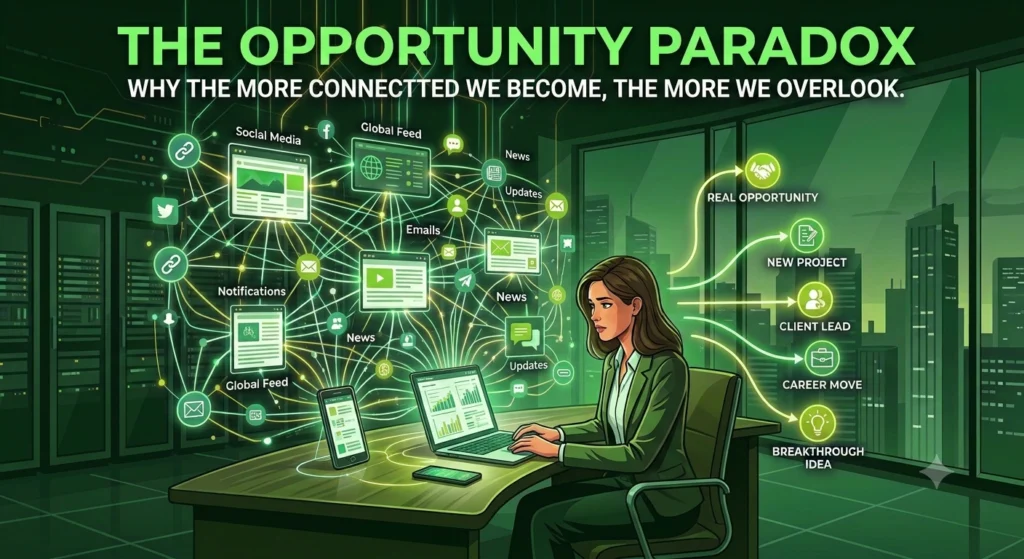
The Opportunity Paradox: Why the More Connected We Become, the More We Overlook
The Connected World: An Introduction to a Modern Paradox The digital revolution has transformed how people communicate, learn, work, and conduct business. Today, individuals can access global information within seconds, collaborate across continents, and explore opportunities that previous generations could hardly imagine. Businesses can reach international audiences, entrepreneurs can launch online services with relatively limited resources, and professionals can develop valuable skills through digital platforms. However, despite these advantages, many people still struggle to identify opportunities that could improve their lives or businesses. This situation reveals an interesting contradiction: the more connected we become, the more opportunities we can access, yet the harder it can become to recognise the opportunities that truly matter. This contradiction forms the foundation of what we can call the opportunity paradox. Although digital connectivity expands our possibilities, information overload, constant distraction, and dependence on familiar patterns can prevent us from recognising valuable possibilities. Therefore, understanding this paradox can help individuals and organisations use technology more thoughtfully and transform digital access into meaningful progress. The Opportunity Paradox: What Does It Really Mean? The opportunity paradox describes a situation in which increasing access to information, technology, and connections does not necessarily lead to better decisions or greater success. In theory, more information should help people identify more possibilities. In practice, however, an overwhelming number of choices can make it difficult to determine which possibilities deserve attention. For example, an entrepreneur who wants to establish an online business may encounter hundreds of business models, marketing strategies, software tools, and success stories. Instead of choosing a direction and testing an idea, the entrepreneur might spend months researching alternatives. Consequently, the abundance of information delays action rather than encouraging progress. This example demonstrates an important principle: opportunities create value only when people can recognise, evaluate, and act on them effectively. Access alone cannot guarantee results. The Information Flood: When More Knowledge Creates Less Clarity The internet has made information widely accessible. Search engines, social media platforms, online courses, podcasts, and digital publications provide continuous streams of knowledge. Nevertheless, people must now process more information than they can reasonably evaluate in detail. This situation creates information overload, which can weaken concentration and make decision-making more complicated. Furthermore, digital platforms often reward content that attracts immediate attention rather than content that provides lasting value. As a result, users may encounter repeated discussions about trending technologies, popular businesses, and overnight success stories. These messages can create the impression that every new trend represents an urgent opportunity. However, not every trend deserves attention, and not every popular strategy suits every individual or organisation. To overcome information overload, people should define clear goals, select reliable sources, and focus on information that helps them solve specific problems. The Attention Economy: Why Visibility Can Hide Valuable Opportunities In the digital economy, attention has become a valuable resource. Businesses compete for clicks, views, engagement, and customer interest, while individuals compete to build audiences and establish their online presence. Although this competition can create opportunities, it can also encourage people to focus on what receives the most attention rather than what delivers the greatest value. For instance, a business owner might invest heavily in creating viral social media content while overlooking customers who need detailed product information or reliable after-sales support. Similarly, a digital marketer might prioritise engagement metrics without examining whether a campaign generates qualified leads or sales. Therefore, businesses should distinguish between visibility and meaningful results. By understanding customer needs and evaluating performance against clear objectives, they can discover opportunities that popular trends and surface-level metrics may conceal. The Fear of Missing Out: How Constant Comparison Distorts Decisions Social media allows people to observe the activities, achievements, and opinions of others almost continuously. Although this access can inspire learning and collaboration, it can also encourage unhealthy comparison. People may believe they are falling behind whenever they see someone launching a business, learning a new skill, or achieving professional success. Consequently, they may abandon promising plans to pursue whatever appears successful at the moment. An entrepreneur might repeatedly change business ideas, while a marketer might adopt every emerging advertising strategy without measuring its effectiveness. This behaviour creates activity without necessarily producing progress. Instead, individuals should evaluate opportunities according to their own goals, available resources, and customer needs. By concentrating on a clear direction and reviewing results consistently, they can avoid distractions and make more informed decisions. The Artificial Intelligence Paradox: More Capabilities, Greater Responsibility Artificial intelligence has expanded the range of tasks that individuals and businesses can perform. AI tools can support research, generate draft content, analyse data, automate routine processes, and assist with customer communication. These capabilities can reduce repetitive work and help organisations explore new possibilities. However, the availability of powerful tools does not automatically guarantee better outcomes. When people rely on AI without defining the problem they want to solve, they may produce large amounts of content or data without gaining meaningful insight. For example, a company could use AI to generate hundreds of social media posts while neglecting its brand positioning, audience research, and customer service. Therefore, organisations should treat AI as a tool that supports human judgement rather than a substitute for strategic thinking. The greatest opportunity often emerges when people combine technological capabilities with industry knowledge, creativity, and a clear understanding of human needs. The Digital Marketing Blind Spot: Reaching Everyone but Understanding Few Digital marketing allows businesses to reach audiences through search engines, social media, email, websites, and online advertising. Moreover, analytics tools help marketers examine user behaviour and measure campaign performance. Despite these advantages, businesses can still overlook important opportunities when they focus on audience reach without understanding the people behind the numbers. For example, a company might receive thousands of website visits but generate very few enquiries. Rather than immediately increasing its advertising budget, the company should examine its landing pages, messaging, pricing, and conversion process. It should also investigate whether its content answers the questions potential customers ask before making a purchase. By improving the customer journey,